The article discusses complex systems, from cities to living forms, to natural forces of evolution. Weinstock presents a new way to think about systems and relationships of parts within a whole. It is the interactions of these parts to their surroundings that produce a coherent form. Examples include schools of fish and flocks of birds, showing the collective behavior of individual organisms result in complex, self-organized forms.
The example of a tree branching was particularly interesting - how it evolved to optimize transportation for fluids, while also maintaining structural stability and maximizing surface area for photosynthesis. The form is not just one thing - but instead a series of parts whose interactions produce a more complex form.
The high level of complexity that is produced from these interactions makes it very difficult to predict the outcome. This relates heavily to our work with Digital Project in that we can make a prediction of the parts final form, but when including multiple relationships, it proves much more difficult. I look forward to exploring what we can produce with digital project, and seeing the unpredictable complexities that develop.
Sunday, February 9, 2014

Sunday, February 2, 2014
P002 - Campidoglio
This is campidoglio re-envisioned...
I made the constraints much cleaner, and made everything based on the outside rectangle. The rectangle has two diagonals, making the center point, on which all the circles are based off of. The diagonal construction lines in the circles are based on a pi/8 formula, which is based off the radius of the largest circle. The radius of the smaller circles are all related to the largest as well.

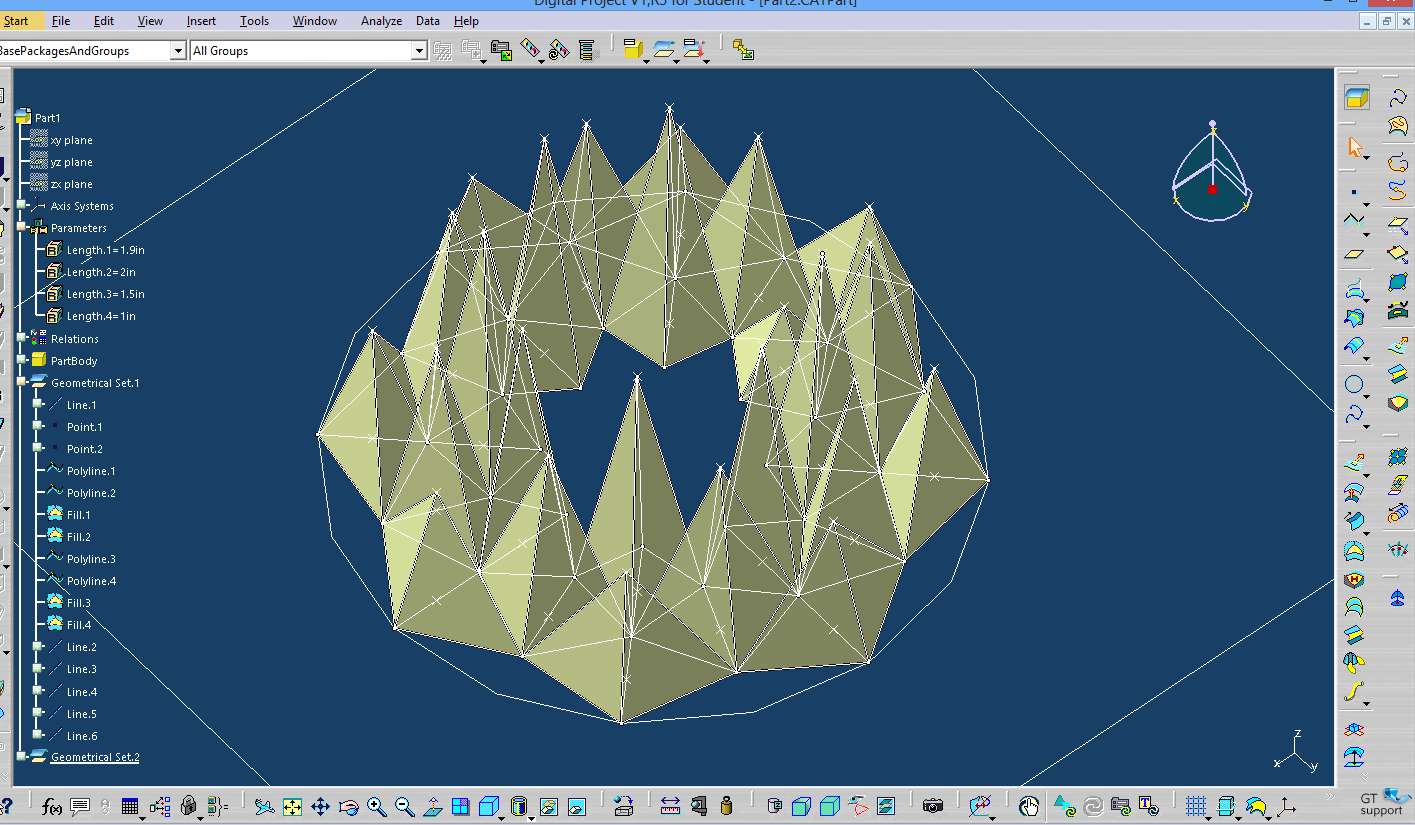
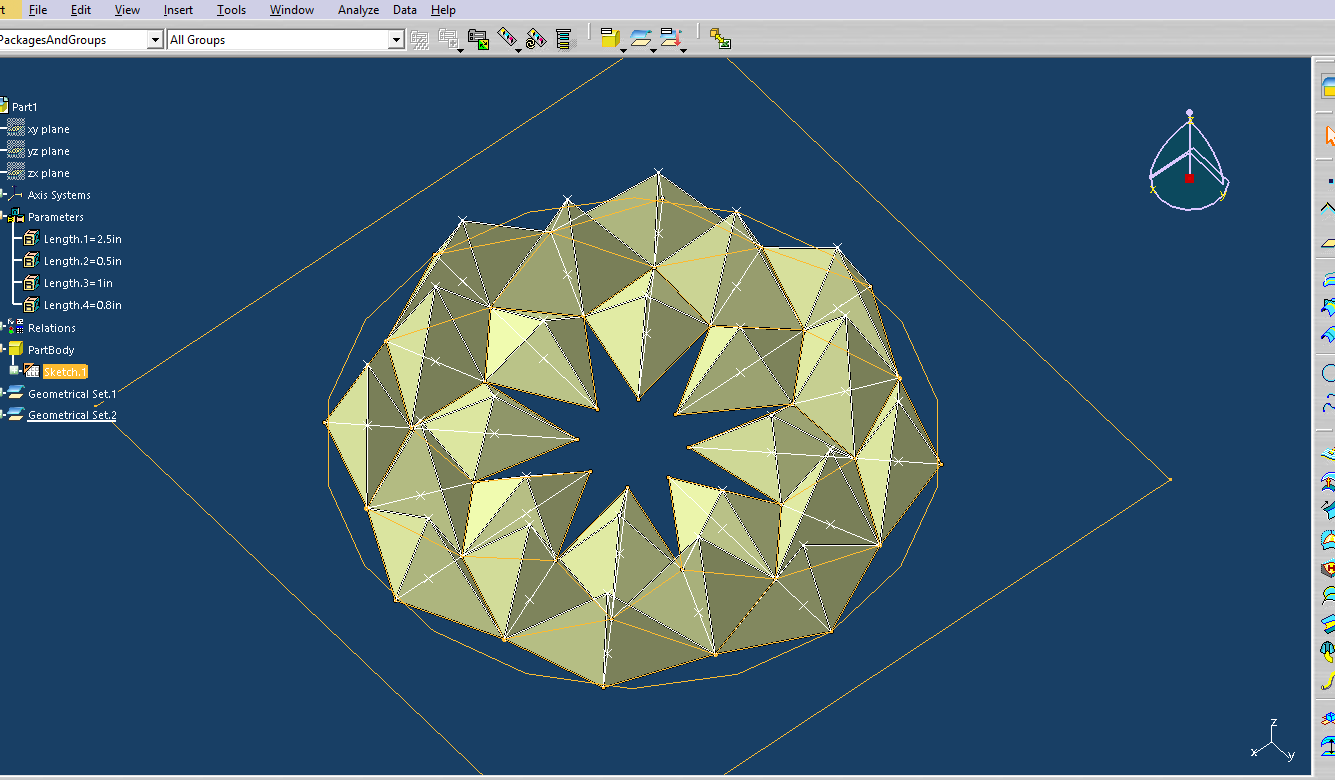
For the solids component, I made the campidoglio into a mountain range/ artichoke.

I built lines between the nodes, placed points on the midpoint, and then made a vertical point based on those midpoints. The polylines connected everything, on which I put a surface. A wise person once told me that triangles are helpful because they don't break:)

All three layers completed: Originally the Z heights were based off of set length parameters for simplicity. Then I played with them changing with the radius of the inner circles of the plan.




P002 - Digital Design and Manufacturing response
This reading was a great supplement to how to work and think in Digital Project. From experience of re-modeling project 001 again, it's by far easier to plan the relationship of components ahead instead of determining them as you go, or as an afterthought. Design can't be thought of as solely final form anymore, and designer must focus on the assembly and relationship of components. Digital Design and Manufacturing underlines this importance of breaking down projects into components in software, in order to facilitate the translation into physical construction.
The reading dives into the breakdown of many digital techniques, including surface and volumetric modeling. Turns out that the breakdown of physical manufacturing processes contains this same logic. The final step in digital modeling is the ability to perform specific analysis on components. With programs like Digital Project, we are more able to accurately predict the behavior of designed components digitally, thus informing the process of physical manufacturing.
The reading dives into the breakdown of many digital techniques, including surface and volumetric modeling. Turns out that the breakdown of physical manufacturing processes contains this same logic. The final step in digital modeling is the ability to perform specific analysis on components. With programs like Digital Project, we are more able to accurately predict the behavior of designed components digitally, thus informing the process of physical manufacturing.
Sunday, January 26, 2014
P001 - CATIA campidoglio
Whelp. This is second time around because my computer crashed. YAY.
I picked one of my favorite spots in Rome - the campidoglio. I started with a bounding box and an oval in the center from cross points. The boxes in the corners changed size based on the desired stairwell width. The inside is composed of diagonal construction lines spaced from the horizontal center line, as well as concentric circles based off of each other's radius.


My variations:
Bounding box (perpendicular vs. parallelogram)
Size of main circle

Size of inside circles (changing size of cross hatching)

Size of diagonal construction line spacing

Offsetting center point
 Getting carried away

I picked one of my favorite spots in Rome - the campidoglio. I started with a bounding box and an oval in the center from cross points. The boxes in the corners changed size based on the desired stairwell width. The inside is composed of diagonal construction lines spaced from the horizontal center line, as well as concentric circles based off of each other's radius.
My variations:
Bounding box (perpendicular vs. parallelogram)


Size of main circle
Size of inside circles (changing size of cross hatching)
Size of diagonal construction line spacing
Offsetting center point
I learned that it was super easy for everything to get carried away, especially when points "looked" like they were snapping and weren't. It pays to be careful and set everything up, so when you change one thing, it moves seamlessly.
Wednesday, January 22, 2014
Reading Response - Loukissas [Keepers of the Geometry}
This reading speaks to the hesitance many face in terms of new technology. The examples of Morris and Thorndike's collaboration and different methods of thinking (through drawing vs. computing) struck home in terms of my experience working at a firm. The principals would often work in trace, trusting my computer expertise to choose the appropriate computing program for modeling and representation.
Having come from UVA, a school that focuses on hand-modeling and drafting, I find it almost impossible to model solely in a computer. However, I see many of my classmates unable to think in anything but rhino. This disconnect will most likely ease as the generation of technology becomes senior partners at firms - it seems that once you "think in the computer" that it is a much smaller step to learn new computing programs. Then again, many people do get set in their ways, no matter what, and there will always be those who refuse to do differently than how they've been taught.
Having come from UVA, a school that focuses on hand-modeling and drafting, I find it almost impossible to model solely in a computer. However, I see many of my classmates unable to think in anything but rhino. This disconnect will most likely ease as the generation of technology becomes senior partners at firms - it seems that once you "think in the computer" that it is a much smaller step to learn new computing programs. Then again, many people do get set in their ways, no matter what, and there will always be those who refuse to do differently than how they've been taught.
Subscribe to:
Posts (Atom)